Forehead Reduction
What Is Forehead Reduction?
Facial proportions depend on the relationship between the forehead, eyebrows, hairline, and other facial features. Some individuals naturally have a higher hairline or larger forehead, which may influence their preferred facial appearance.
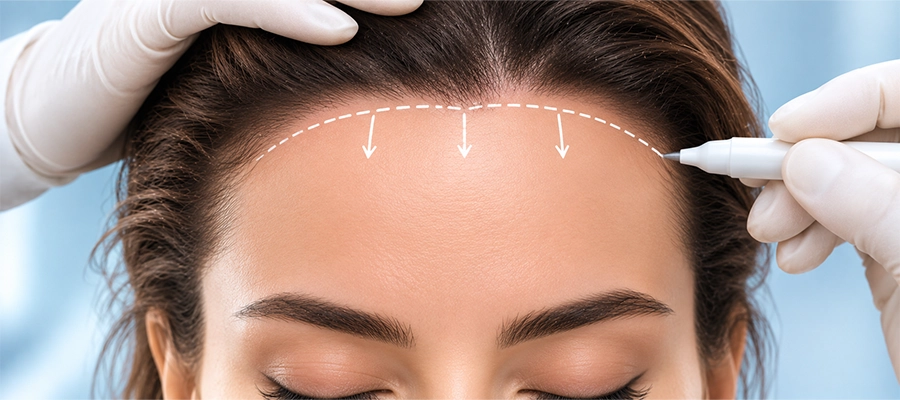
In aesthetic surgery, forehead reduction is a procedure designed to decrease the visible height of the forehead by advancing the hair-bearing scalp toward the eyebrows. It is also commonly called surgical hairline lowering or scalp advancement.
The procedure aims to create a more balanced relationship between the upper, middle, and lower facial regions. However, results depend on scalp flexibility, hairline characteristics, surgical planning, and individual healing. Not everyone with a high forehead is a suitable candidate.
How Does Forehead Reduction Surgery Work?
The operation begins with an examination of the existing hairline, forehead dimensions, and scalp mobility. The surgeon determines how far the hair-bearing scalp can safely move forward without creating excessive tension.
During forehead reduction, an incision is generally made along the frontal hairline, and a strip of forehead skin is removed. The surgeon advances the scalp and secures it in a lower position before carefully closing the incision. The procedure is performed under appropriate anesthesia, and postoperative swelling, tenderness, and temporary numbness may occur.
Who Is a Good Candidate for Forehead Reduction?
Surgical suitability depends on forehead height, scalp elasticity, hair density, and the stability of the existing hairline. Individuals with naturally high foreheads and adequate scalp mobility may be suitable candidates.
Before recommending forehead reduction, a qualified surgeon should assess the risk of future hair loss, previous scalp surgery, medical history, and realistic aesthetic expectations. Patients with progressive hairline recession, limited scalp flexibility, or certain scalp conditions may require a different approach.
What Causes a High or Large Forehead?
Forehead height varies naturally because of genetics, facial bone structure, and the position of the hairline. Some people inherit a high frontal hairline despite having otherwise healthy, dense scalp hair.
For individuals considering forehead reduction, it is important to distinguish a naturally high hairline from one that has receded because of androgenetic alopecia, traction alopecia, or other conditions. Progressive hair loss can affect the long-term appearance of a surgically lowered hairline and may influence treatment selection.
What Are the Benefits of Forehead Reduction Surgery?
Surgical hairline lowering can reduce the visible distance between the eyebrows and the frontal hairline. This may improve facial proportions for individuals who feel their forehead appears disproportionately tall.
When appropriately planned, forehead reduction can provide an immediate change in hairline position without waiting for transplanted follicles to grow. The procedure also uses the patient’s existing hair-bearing scalp, potentially preserving donor follicles for future treatment. However, the resulting hairline scar and individual healing characteristics must be considered.
What Are the Limitations of Forehead Reduction?
The amount of achievable hairline advancement is limited by scalp mobility and the tension that develops during closure. Excessive advancement can increase the risk of wound complications or an unfavorable scar.
Patients considering forehead reduction should also understand that surgery does not prevent future hereditary hair loss. Potential complications include bleeding, infection, visible scarring, altered sensation, hair loss near the incision, and asymmetry. Some patients may need additional procedures to improve hairline shape or conceal a scar.
What Is the Difference Between Forehead Reduction and Hairline Lowering?
The terms forehead reduction and surgical hairline lowering are frequently used interchangeably. Both generally describe an operation that advances the hair-bearing scalp to reduce visible forehead height.
In most clinical discussions, forehead reduction is the surgical method used to achieve hairline lowering. However, hairline lowering can also be accomplished cosmetically through hair transplantation, which adds follicles below the existing hairline rather than advancing the scalp. The distinction should be clarified during consultation.
Forehead Reduction vs. Hair Transplant: Which Is Better?
These procedures lower the apparent hairline through different mechanisms. Surgical scalp advancement physically moves the existing hairline forward, while hair transplantation relocates follicles into previously uncovered forehead skin.
For suitable patients, forehead reduction may offer an immediate reduction in forehead height, particularly when the scalp is flexible and the frontal hairline is stable. Hair transplantation may be preferable for patients with limited scalp mobility, specific hairline-shaping goals, or concerns about a continuous surgical scar. Neither option is universally better.
Can Forehead Reduction Surgery Make Your Forehead Smaller?
Surgical scalp advancement can decrease the visible vertical height of the forehead by bringing the hairline closer to the eyebrows. The underlying forehead bone structure remains unchanged.
Following successful forehead reduction, the upper facial region may appear shorter and more proportionate. However, the procedure does not narrow the forehead, reshape the frontal bone, or alter the position of the eyebrows. The final aesthetic effect depends on individual facial anatomy.
How Many Centimeters Can Forehead Reduction Surgery Lower the Hairline?
The amount of hairline advancement varies according to scalp elasticity, forehead dimensions, and surgical technique. Some patients can achieve a modest reduction, while others have sufficient mobility for a more substantial change.
During forehead reduction, advancement of approximately 1–3 centimeters may be achievable in selected cases, although this is not a guaranteed range for every patient. Greater movement may require additional surgical planning or staged approaches. A surgeon must assess scalp tension before determining a safe target.
How Does Scalp Elasticity Affect Forehead Reduction Surgery?
Scalp elasticity describes how readily the scalp can stretch and move without excessive tension. This characteristic plays a major role in determining whether surgical hairline advancement is feasible.
Before forehead reduction, the surgeon evaluates scalp mobility through physical examination and reviews factors that may restrict movement, such as previous surgery or scarring. Limited elasticity can reduce the achievable advancement and increase closure tension. Attempting to move the scalp too far may compromise healing or scar quality.
Forehead Reduction Prices 2026
In 2026, the cost of forehead reduction varies according to the complexity of the operation, the surgeon’s experience, the healthcare facility, and the anesthesia required.
Frequently Asked Questions
Is Forehead Reduction Surgery Safe?
Surgical hairline lowering carries risks including bleeding, infection, scarring, altered sensation, and wound-healing complications. When appropriately performed, forehead reduction can be safe for carefully selected patients under qualified surgical care. A detailed medical assessment is necessary before proceeding.
Is Forehead Reduction Surgery Painful?
Appropriate anesthesia is used to prevent pain during the operation. After forehead reduction, patients may experience temporary tightness, swelling, tenderness, or numbness around the incision. Pain that becomes severe or progressively worsens requires medical evaluation.
What Is the Best Age for Forehead Reduction?
There is no single ideal age because suitability depends on facial development, hairline stability, and overall health. For individuals considering forehead reduction, surgeons generally prefer to assess whether the hairline is mature and whether progressive hair loss could affect the result. Younger patients may require additional caution.
Can Forehead Reduction Be Performed Without Surgery?
A true reduction in forehead height through scalp advancement requires surgery. Although hairstyles, cosmetic camouflage, and hair transplantation may change the apparent hairline, forehead reduction itself involves repositioning the hair-bearing scalp. Nonsurgical products cannot physically move the natural hairline downward.
Can Forehead Reduction Make a Big Forehead Look Smaller?
Advancing the hairline can decrease the visible vertical distance between the eyebrows and scalp hair. For suitable patients, forehead reduction may make a high forehead appear shorter and more balanced. However, the procedure does not change forehead width or underlying bone structure.
How Much Can Your Forehead Be Reduced in One Surgery?
The achievable reduction depends mainly on scalp elasticity and the amount of tension that develops during advancement. In selected cases, forehead reduction may lower the hairline by approximately 1–3 centimeters, but individual limits vary. A surgeon must determine what can be achieved safely rather than promising a fixed measurement.
Is a 2 cm Forehead Reduction Possible?
A two-centimeter advancement may be feasible for patients with sufficient scalp mobility and suitable hairline characteristics. During forehead reduction, the surgeon evaluates whether this distance can be achieved without excessive tension or increased wound-healing risk. The final amount must be determined through an individual examination.
Can You Get a 3 cm Forehead Reduction?
Three centimeters of hairline advancement may be possible in selected patients with particularly favorable scalp elasticity. However, a forehead reduction of this size is not suitable or safely achievable for everyone. Patients should discuss the expected advancement, scar placement, and potential complications with an experienced surgeon.